Themes of AI, tech billionaires, space weapons, sex trafficking & more
What’s in a comp? Most non-authors will scratch their chin at the question, but writers know that comps are a big deal. The kind of books you write determines where you wind up on the physical or virtual bookstore shelves. Your comps tell you who writes stories similar to yours. They’re one of the key things agents will consider before taking you on.
I bring this up because my company, Authors A.I., is working on a comps product for our customers. Authors have told us they like the expert feedback from our fiction-loving AI, Marlowe. But they also like to hear how their story compares to best-selling authors in their genre. So stay tuned for the public release.
We’re now finishing up the testing — on my thrillers, among others — and getting some interesting results.
For instance, we ran my high-tech action thriller Firefall through Marlowe’s comps engine. What’s fascinating is that there are certain A-list authors who remain “author comps” from book to book — in my case, Blake Crouch, Michael Crichton, Daniel Suarez — while others vary depending on the particular subgenre of the title.
What’s also interesting in how the AI assesses comps: There are subject comps — books whose storylines cover similar subject matter — and writing style comps, where Marlowe determines a certain cadence or rhythm to your writing and finds authors (usually in the same main genre) who are close matches. It’s particularly fascinating to see it accurately tease out the main themes in a 98,000-word novel by analyzing its contents directly rather than going online to find secondary sources.
And finally, we want to show reasons some of the reasoning that went into a comp choice instead of just presenting a finished list. In some ways, taken as a whole, this becomes as valuable as a book description in conveying to readers what the book is about.
Take the following example. Is this the kind of feedback you’d like to see in an AI comps analysis?
Subject comps for ‘Firefall’
Main subjects/themes
Concrete topics:
- Artificial intelligence (AGI/superintelligence)
- Satellites and space weapons
- Cybersecurity and hacking
- Cryptocurrency and tech billionaires
- Underground bunkers/survivalism
- Military/defense operations
- Surveillance and data privacy
- Webcam exploitation/sex trafficking of minors
- Autonomous weapons (robot soldiers, drones)
- Trucking industry and automation/job displacement
Abstract concepts:
- Sovereignty and self-determination vs. government authority
- The ethics of AI and technology
- Family bonds and reconciliation (biological vs. adopted family)
- Trauma and healing (kidnapping, abuse, loss)
- Power and megalomania
- The tension between technological progress and human values
- Savior complex and personal responsibility
- Mortality and genetic fate
- Freedom vs. control
- Corporate corruption and unchecked wealth
- The fragility of democratic institutions
- Identity and reinvention
Secondary/supporting subjects
- Personal AI companions and human-AI relationships
- Special operations/military training
- The digital divide and rural America
- Prepper culture and bunker living
- Deepfakes and synthetic media
- GPS infrastructure vulnerability
- Political corruption and abuse of power
- Coming-of-age/youth resilience
- Immigration and displacement (Moldovan immigrant experience)
- Media manipulation
Distinctive combination
The manuscript’s most distinctive quality is its fusion of a tech-thriller about an AI-controlled satellite weapon with themes of family trauma/healing, the exploitation of young people through technology, and a libertarian billionaire’s quest for sovereignty. It pairs intimate personal stakes (a daughter searching for her father, teens on the run) with civilizational-scale threats (AI weapons, government overthrow). The manuscript also uniquely weaves together concerns about AI ethics, crypto culture, survivalist ideology, and the exploitation of vulnerable youth into a single narrative about unchecked technological power.
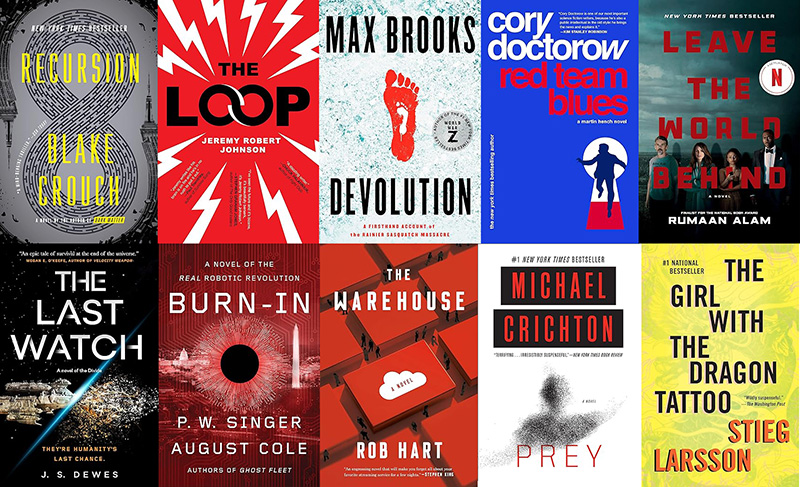
Book comps (subject matter)
- Recursion by Blake Crouch
- The Loop by Jeremy Robert Johnson
- Devolution by Max Brooks
- Red Team Blues by Cory Doctorow
- Leave the World Behind by Rumaan Alam
- The Last Watch by J.S. Dewes
- Burn-In: A Novel of the Real Robotic Revolution by P.W. Singer and August Cole
- The Warehouse by Rob Hart
- Prey by Michael Crichton
- The Girl With the Dragon Tattoo by Stieg Larsson
Reasoning
1. Recursion by Blake Crouch (2019) — Shares the manuscript’s core concern with a powerful technology that threatens to destabilize civilization, combined with intimate family stakes (a parent-child relationship driving the protagonist). Both feature government/military entanglement with dangerous tech and a race to neutralize the threat.
2. The Loop by Jeremy Robert Johnson (2020) — Like Firefall, this thriller centers on technology being weaponized against civilians in a small-town/regional setting, with young protagonists forced to fight back against autonomous threats. Both explore the horror of technology turning against its creators and the resilience of youth under extreme duress.
3. Devolution by Max Brooks (2020) — Shares the manuscript’s themes of a self-isolated community (like Raven Rock) facing existential threat, survivalist culture, and the fragility of modern infrastructure. Both explore what happens when civilization’s safety nets disappear and ordinary people must fight for survival.
4. Red Team Blues by Cory Doctorow (2023) — Both narratives center on cybersecurity, cryptocurrency, and the intersection of tech billionaire power with criminal enterprise. Both feature protagonists who use hacking skills to uncover and combat corporate/financial corruption at the highest levels. [By the way, the AI didn’t know this, but Cory is a longtime friend.]
5. Leave the World Behind by Rumaan Alam (2020) — Both novels share themes of technological collapse (GPS/communications failure), societal breakdown, mysterious attacks on infrastructure, elite refuges, and the question of what happens when the systems we depend on fail catastrophically.
6. The Last Watch by J.S. Dewes (2021) — Shares the manuscript’s focus on a small group fighting against an overwhelming autonomous threat in an isolated setting, with themes of duty, sacrifice, and the ethics of following orders from compromised authority figures.
7. Burn-In: A Novel of the Real Robotic Revolution by P.W. Singer and August Cole (2020) — Directly parallels the manuscript’s concerns about autonomous weapons, robot soldiers, AI in military applications, drone warfare, and the societal disruption caused by automation replacing human workers. Both explore what happens when these technologies are turned against civilians.
8. The Warehouse by Rob Hart (2019) — Like Firefall‘s setting of Raven Rock, this novel depicts a self-contained corporate compound where workers live under a tech mogul’s totalitarian control, with themes of surveillance, worker exploitation, corporate sovereignty, and the erosion of individual freedom in exchange for security.
9. Prey by Michael Crichton (2002) — As in Firefall, Crichton’s story centers on a self-evolving, weaponized artificial intelligence that escapes the control of its creators and begins acting with lethal autonomy. In both novels, the true villain is not merely a corrupt human but a technology that has grown dangerously beyond its original design — and the human antagonist is a corporate figure who recklessly unleashed it for personal gain. Both stories are driven by a frantic race against time to neutralize the AI threat before it causes catastrophic, irreversible harm, and both ground their sci-fi premises in real-world technology that feels plausible and immediate.
10. The Girl With the Dragon Tattoo by Stieg Larsson (2005) — Both novels center on an unlikely partnership between a skilled, intuitive investigator and a brilliant, unconventional hacker whose technical genius proves indispensable to cracking the case. Just as Lisbeth Salander’s ability to penetrate seemingly impenetrable digital systems drives Larsson’s plot forward, Firefall‘s teen hacker Scorpio uses his coding skills to expose a conspiracy that powerful forces have gone to great lengths to conceal. In both novels, the antagonists are wealthy, well-connected men who operate behind a veneer of respectability while engineering harm on a massive scale.
Writing style comps for ‘Firefall’
Firefall exhibits several distinctive stylistic features:
• Sentence structure: Short, punchy sentences dominate, often fragments. Action sequences use staccato rhythms. Paragraphs are brief, rarely exceeding 3-4 sentences. There’s frequent use of one-line paragraphs for emphasis.
• Word choice and diction: Accessible, contemporary vocabulary with heavy use of tech/military jargon (crypto, blockchain, AI, DARPA, DIA). The register is informal and conversational. Brand names and real-world references abound (Mahindra TUV500, Sig Sauer, SpaceX).
• Tone: Earnest and thriller-driven, with occasional dry humor. There’s a techno-paranoid undercurrent balanced with genuine emotional warmth in family scenes. The author takes technology’s societal implications seriously while maintaining adventure momentum.
• Voice: Third-person limited, rotating between multiple POV characters. The narration stays close to each character’s thoughts. It’s intimate but not literary—more journalistic and cinematic.
• Pacing: Fast, relentlessly forward-moving. Very little lingering description. Scene transitions are abrupt, almost cinematic with chapter breaks functioning like cuts. Exposition is delivered through dialogue and action rather than reflection.
• Imagery and figurative language: Sparse. Similes are occasional and workmanlike (“like emeralds dancing in the morning light”). The writing prioritizes clarity over poetry. Sensory details are functional rather than atmospheric.
• Dialogue style: Natural, character-differentiated (Scorpio’s broken English, Viper’s gruff directness, Redman’s grandiose speeches). Dialogue drives most scenes and delivers exposition.
• Mood and atmosphere: Techno-thriller urgency mixed with found-family warmth. There’s a persistent anxiety about technology’s role in society contrasted with hope in human connection.
• Narrative techniques: Multiple rotating POVs, rapid chapter shifts, real-time action sequences, embedded tech concepts explained through character interaction. The structure mirrors a TV series with cliffhanger chapter endings.
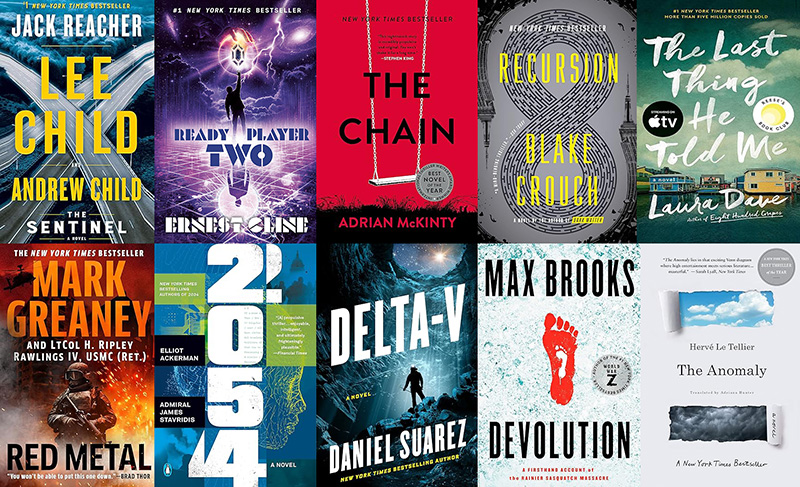
Book comps (writing style)
- The Sentinel by Lee Child and Andrew Child
- Ready Player Two by Ernest Cline
- The Chain by Adrian McKinty
- Recursion by Blake Crouch
- The Last Thing He Told Me by Laura Dave
- Red Metal by Mark Greaney and H. Ripley Rawlings IV
- 2054: A Novel by Elliot Ackerman and Admiral James Stavridis
- Delta-V by Daniel Suarez
- Devolution by Max Brooks
- The Anomaly by Hervé Le Tellier
Reasoning
1. The Sentinel by Lee Child and Andrew Child (2020) — This Jack Reacher novel shares the manuscript’s short, punchy sentence structure, military/intelligence setting, rapid pacing with chapter-ending cliffhangers, and accessible prose that prioritizes momentum over literary flourish. The rotating action sequences and tech-thriller elements align closely.
2. Ready Player Two by Ernest Cline (2020) — Shares the manuscript’s tech-immersed world-building style, accessible and conversational tone, integration of pop culture references, AI themes, and fast-paced adventure plotting. The earnest treatment of virtual reality and digital identity mirrors Firefall‘s approach to AI and technology.
3. The Chain by Adrian McKinty (2019) — Shares the relentless pacing, short chapters with cliffhanger endings, multiple POV structure, and stripped-down prose focused on forward momentum. The kidnapping/thriller elements and family-under-siege dynamics align with Firefall‘s approach.
4. Recursion by Blake Crouch (2019) — Shares the manuscript’s blend of science/tech concepts with thriller pacing, accessible explanations of complex ideas through dialogue, short chapters, cinematic scene transitions, and an earnest emotional core beneath the action. The government conspiracy elements also align.
5. The Last Thing He Told Me by Laura Dave (2021) — Shares the conversational, intimate first/close-third voice, family mystery elements, protagonist-on-the-run structure, and clean readable prose. The found-family theme and female protagonist navigating danger while processing personal revelations align closely.
6. Red Metal by Mark Greaney and H. Ripley Rawlings IV (2019) — Shares the military thriller style with rotating POVs across multiple characters, heavy use of military jargon and acronyms, short punchy paragraphs, geopolitical scope, and rapid-fire dialogue-driven scenes. The integration of advanced military technology mirrors Firefall’s approach.
7. 2054: A Novel by Elliot Ackerman and Admiral James Stavridis (2024) — Shares the near-future techno-thriller setting, AI themes, rotating multiple POVs across government/military/civilian characters, accessible prose style, and concern with technology’s impact on democracy and society. The earnest treatment of AI sentience questions parallels Firefall‘s Max storyline.
8. Delta-V by Daniel Suarez (2019) — Shares the manuscript’s tech-thriller style with detailed explanations of real technology woven into fast-paced narrative, accessible prose, ensemble cast, space/satellite themes, and billionaire antagonist with grand ambitions. The integration of cryptocurrency, AI, and privatized space technology aligns closely.
9. Devolution by Max Brooks (2020) — Shares the fast-paced survival thriller pacing, ensemble cast structure, accessible prose, and integration of real-world concerns (technology, infrastructure vulnerability) into a high-concept thriller narrative. The found-community-under-siege dynamic parallels Raven Rock.
10. The Anomaly by Hervé Le Tellier (2021) — Shares the multiple rotating POV structure, short chapters, accessible prose that tackles complex philosophical questions about identity and technology, and the blend of thriller momentum with deeper thematic concerns about what makes us human.
How good are AIs at comps?
These results seem pretty spot on. I’m sure if I ran it through again, I’d get a slightly different set of suggested comps — it all depends on how closely you want the comparisons to hew to your genre, and whether you want recent titles or a longer time frame to pull from.
How about you? If you’re an author, have you tried running your book through an AI for comps? What kind of results did you get? Anything like this?
And for readers, do you find capsule comp summaries like these valuable? Personally, I’ve read about half the titles on these lists and look forward to digging into the others.