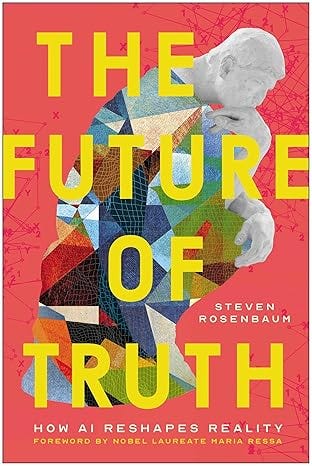
Steve Rosenbaum’s new book on the precariousness of truth in the AI Age
I use AI nearly every day. I use it to research, to synthesize, to brainstorm. And if you’re reading this, chances are you do, too. So when I sat down on a Zoom call Friday with old friend Steve Rosenbaum to talk about his new book, The Future of Truth: How AI Reshapes Reality, I wasn’t sure whether Rosenbaum falls into the anti-AI camp like so many others online.
Not quite. Rosenbaum uses AI daily – but with a journalist’s skeptical eye.
Rosenbaum, an Emmy-winning filmmaker and co-founder of the Sustainable Media Center in New York, has spent the past four years on a deep dive into the nature of truth. That journey has culminated in The Future of Truth, which releases today from BenBella Books (distributed by Simon & Schuster), featuring conversations with some of the sharpest minds around (including many members of my old crew) – Larry Lessig, Esther Dyson, David Chalmers, Douglas Rushkoff, Gary Marcus, and many others.
The book’s central argument is one that should give all of us pause: AI isn’t just another technology cycle. It represents a structural change in how humanity processes and perceives reality. And if we’re not paying careful attention, it’s going to take us to some very challenging places as a society.
Misinformation: from hobby to science
When I asked Rosenbaum what makes AI fundamentally different from the technological disruptions and business/media forcews that came before, he didn’t mince words.
“Misinformation is going from being a hobby to being a science,” he told me.
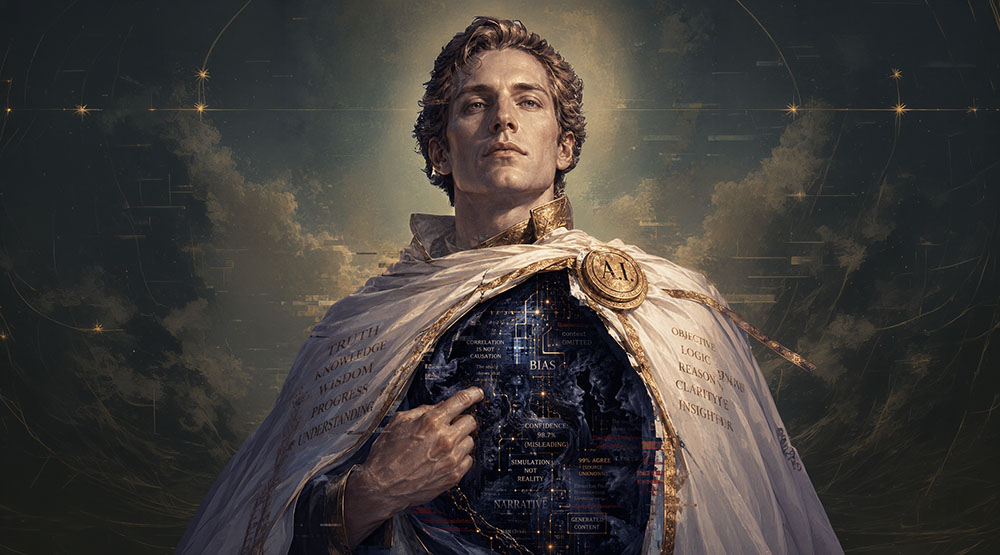
Think about that for a moment. We’ve always had sources of misinformation – media outlets and political figures who outright lie. What’s changing now is the scale, speed, and precision with which AI can deliver personalized lies (and falsehoods that might as well be lies) directly to your desktop or mobile device – lies that can trigger you like nothing that came before.
Rosenbaum shared an example. He’d seen an image from the Iran conflict – a drone striking a tower in Saudi Arabia – that he later found out was fabricated. Yep, a deepfake video. But here’s the thing: he can’t unsee it. The image is lodged in his memory, and no amount of fact-checking can erase it. Our brains simply don’t work that way. We can’t delete false memories the way we’d delete a file on our computers.
It gets worse. AI can now manufacture video that is virtually indistinguishable from the real thing. If someone fabricates a video of you (or a public figure) doing something terrible, you can try to rebut it, but there will always be a certain number of people who won’t believe the truth.
The strategic weaponization of disbelief
What really concerns Rosenbaum isn’t just that AI can produce better lies. It’s the broader strategy behind it all. Even before AI came along, there’s been a deliberate political strategy aimed at getting people to say, “I don’t know what to trust, so I trust nothing.”
AI is the vehicle that turbocharges that strategy. It delivers personalized disinformation with unprecedented speed and targeting. When confronted with the endless dialectic of “Is that real? Look at the clouds, they’re moving backward” – many of us say with resignation,
“Forget it, I’ve got to go to the grocery store.”
When people throw up their hands and give up, that’s a win for the bad guys. As Rosenbaum put it, totalitarianism needs the public to choose to stay home.
The non-fat yogurt problem
I loved Rosenbaum’s analogy about what he calls the dangerous convenience of AI. He likened it to the old Seinfeld episode about non-fat yogurt – the one where the yogurt tastes too good, and it turns out it’s not actually non-fat.
AI is about to make a lot of stressful things in our lives seem simpler. Booking travel, dealing with insurance companies, navigating healthcare bureaucracy – all those logistical headaches that eat up our days. Agentic AI promises to handle all of it for us. And there will come a moment when many of us exhale and think, “That was great.”
But be careful what you wish for. If you’re not paying for an AI service that’s giving you prescriptions, driving directions, or vacation plans, someone else is paying – and the service isn’t neutral. As the old saying goes, if it seems too good to be true, it probably is.
He pointed to credit scores as a chilling example of what happens when algorithms become the final authority. If an automated system gets your credit score wrong, good luck getting a hearing. You’re not going to talk to anyone at Experian. The computer’s determination becomes a non-negotiable label, and you’re stuck wearing it. During COVID, automated test proctors flagged students as cheaters, and universities treated the machines’ judgment as gospel. There’s something deeply troubling about a world where algorithmic labels become impossible to challenge.
Hallucinations … or distortions?
Rosenbaum doesn’t offer prescriptions or full-on solutions in his book, but it carries plenty of warnings for us across a wide terrain: health, finance, politics, media.
Too often, truth is an inconvenience to the large language models. Rosenbaum uses AI daily – for synthesis, interview and meeting prep, responding to complex proposals – and he finds the LLMs “sometimes brilliant.” But too often, he’ll feed a transcript into ChatGPT, ask it to pull out five good quotes, and it will deliver quotes that aren’t in the original material. When he pushes back, the AI apologizes and asks if he wanted quotes that are actually quotes.
While some of the most egregious examples of hallucinations appear to be dwindling in number, some issues remain intractable. Why, for example, can’t these machine count? Ask it for the word count of a manuscript and the answer will be dramatically off. “That’s just bad code,” he said. (It’s more complicated than that, but all right.)
When LLMs fabricate quotes and present them as real? That’s something else entirely. And we shouldn’t let the industry off the hook with a cute euphemism.
Young people are mostly getting this right
One part of our conversation surprised me. When I asked Rosenbaum whether the next generation is in trouble – whether young people forming media habits around AI will be unable to separate fact from fiction – he pushed back.
“I’m more concerned about our generation than the next generation,” he said.
Through his work running the Sustainable Media Center, Rosenbaum interacts with young people regularly, and he says they are more skeptical and careful than their elders. They don’t take things at face value. They look for sources (usually). They read extensively (well, some of them). It’s the older generations, he argues, who are consuming politicized media and accepting it as fact without question.
That’s a counterintuitive finding, and I think it’s an important one. We tend to assume that digital natives are more susceptible to digital manipulation, but Rosenbaum’s experience suggests the opposite: growing up inside the firehose of information may actually be producing a more media-literate generation. It’s the folks who came of age trusting their evening news anchor who may be most vulnerable now, he says.
That said, Rosenbaum does worry about young writers, ages 12 to 15, who are using AI before they’ve had a chance to develop their own voice. Established writers like him and me have a body of work that AI has learned from, so when it generates drafts in our style, we can recognize what’s ours and what’s not. But if you’re a teenager and AI is doing the writing before you’ve ever found your own cadence? That’s a different and potentially dangerous situation for the next generation of writers.
Truth hunting is hard work – but it’s necessary
Rosenbaum deliberately avoids being prescriptive in the book. AI, like words themselves, is a broad communication framework that can be used for good or for ill. The book takes readers on a journey through AI’s impact on art, warfare, journalism, dating, and more, and by the time you’re two-thirds of the way through, the cumulative effect hits you: this thing is going to touch everything.
But he does believe in accountability. Bellwether cases in New Mexico and Los Angeles are beginning to establish product liability as a new legal framework for AI platforms, moving beyond the protections of federal Section 230. Rosenbaum points out that we’ve been here before – cigarettes used to be everywhere, Ford Pintos used to explode on the highway, nobody used to wear seatbelts. Change does happen, but it takes time and pressure.
When Rosenbaum returns to the subject of the need for an informed public to be truth-hunters, I’ll confess that, while I agree with his call to arms, I don’t think most people are up to the task. Just look at how many millions of people believed in the ruse that the pope endorsed Trump before the 2016 election – an easily disproven bit of propaganda.
Truth is the ultimate currency

Near the end of our conversation, Rosenbaum said something jarring: “At the point at which truth is irrelevant, I get to open a bagel store.”
If truth becomes meaningless, the entire enterprise of journalism, writing, and art loses its purpose. Every journalist, every author, every artist, every musician, every screenwriter – they’re all telling a version of the truth. And that’s not something we should hand over to the robots.
I’d recommend picking up The Future of Truth – not because it will give you a neat set of answers, but because it will make you a more thoughtful, more vigilant consumer of information. In the world we’re heading into, we’re all going to need to become truth hunters. It’s going to take more work. But the alternative is to let the machines decide what’s real, and I don’t think any of us want to live in that world.
Rosenbaum kicks off a two-week book tour today, with events scheduled at bookstores and venues across New York. One highlight: an appearance at the New York Public Library on May 20 with Marty Baron, the former executive editor of The Washington Post whose newsroom leadership was immortalized in the Academy Award-winning film Spotlight. (The event will be live-streamed for free; register here. Check thefutureoftruth.us for the full schedule and details.)
What do you think? Are we up to the challenge of being truth hunters in the age of AI? Drop your thoughts in the comments.